
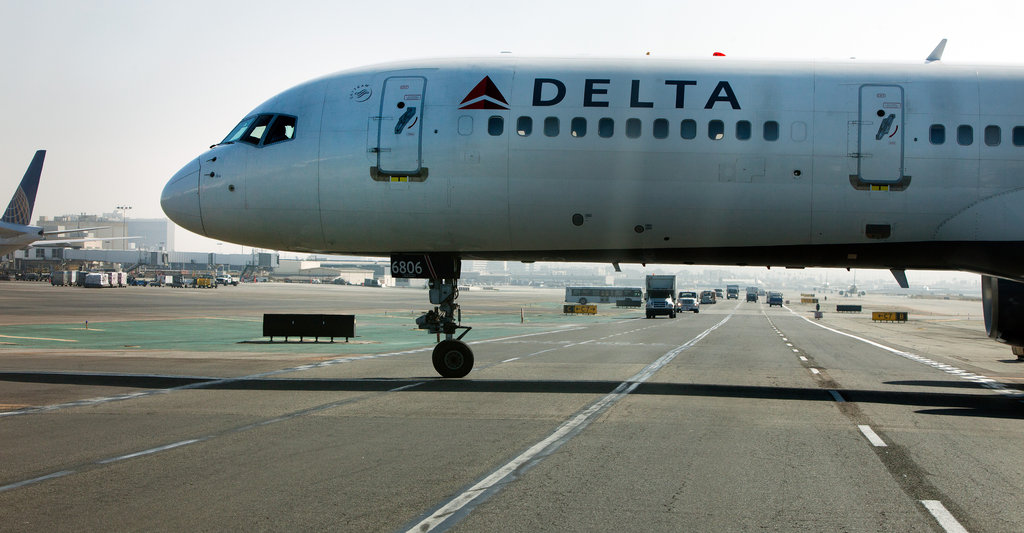
Safer Flights, but Risk Lurks on the Runway
Southwest Airways Flight 844 from Minneapolis had just landed at Chicago’s Midway International Airport last December and was about to cross a runway on its way to the terminal when the co-pilot noticed a business jet barreling toward him. He shouted for the captain to stop. The plane, carrying 74 passengers, screeched to a halt just short of the runway as the smaller jet crossed before their eyes.
Seconds later, the Southwest pilot called the control tower. “I want you to acknowledge you cleared us on a runway while a plane was taking off,” he said. “We had to hit the brakes and the thing went right over our head.”
Though most passengers may not be aware of the hazards on the ground, such near misses are not isolated events. Since 2008, there have been about three incidents a day in which a plane or a vehicle gets on an active runway by mistake, an average of 1,000 a year. That number has held steady for the last four years while the total number of flights has declined.
In a small number of these cases, a catastrophic collision is narrowly avoided — sometimes only through sheer luck.
The issue has festered even as regulators and the airline industry have made significant gains in reducing other major aviation hazards, especially those in flight. Advances in navigation technology in recent decades, for instance, have sharply reduced midair collisions and crashes into mountains and other obstacles, two of the most common causes of accidents.
But a similar urgency to address runway safety has lagged, safety experts said. Only in the last year have all 35 major airports installed new ground radars that provide air-traffic controllers a better view of the runways, and a handful of airports are now testing a new system of warning lights on runways.
“These incidents remind us how vulnerable we are when procedures or people fail,” said Deborah Hersman, chairwoman of the National Transportation Safety Board, which has put runway safety on its top 10 list of priorities since 1990.
The Federal Aviation Administration said the number of runway incidents that it classifies as most severe — in which a collision is narrowly avoided — has dropped in the last decade. In 2000, there were 67 serious incidents, only half involving a commercial aircraft, compared with just 12 in 2011.
Still, the Government Accountability Office, an auditing arm of Congress, said there were 18 incidents per million flights in 2010, up from 11 per million in 2004. The safety board said about a dozen incidents are serious enough to warrant an investigation each year.
Airports, particularly major hubs, are busy places that can handle more than a hundred flights an hour, while thousands of fuel trucks, bag tugs, catering trucks and many other vehicles crisscross the airfield.
Most incidents involve jets, but there have also been cases where fire trucks, helicopters, animal control vehicles, police cars and even pedestrians, cross runways by mistake in recent years. In one instance, a Boeing 767 landing at Honolulu International Airport in 2009 was forced to slam on the brakes to avoid striking an F-15 fighter jet that had stopped on the runway. The pilot realized there was an obstacle only when he saw the F-15’s tailpipes and stopped 200 feet from the fighter.
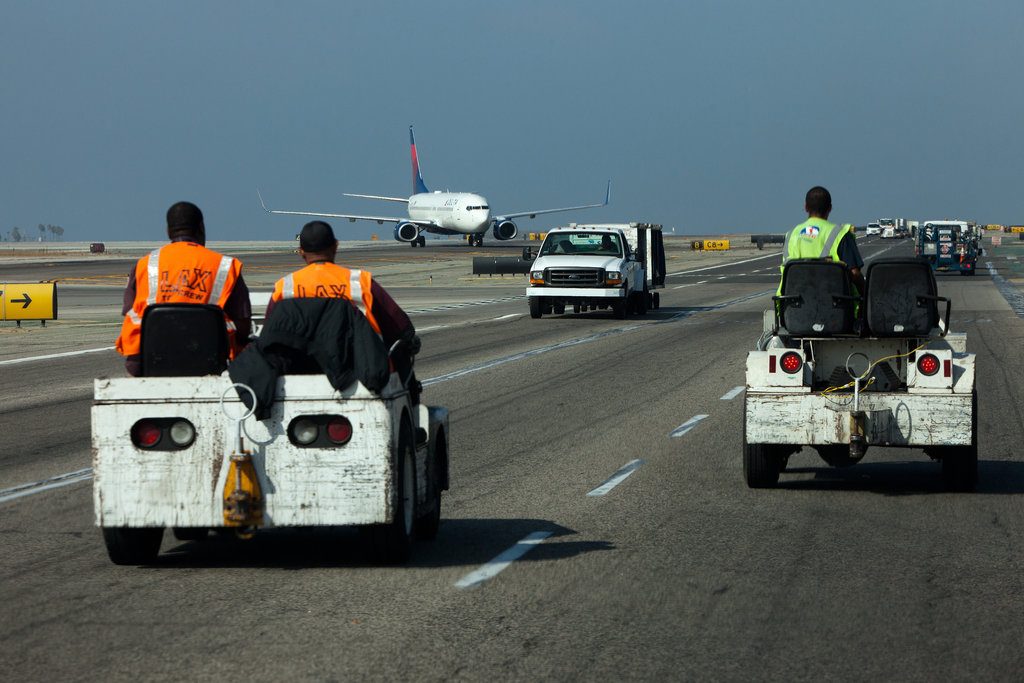
In 65 percent of cases, pilots are blamed, according to the F.A.A. In a few extreme cases, pilots have landed on a taxiway. In 2009, for instance, a Delta Air Lines Boeing 767 coming from Rio de Janeiromistook a taxiway for a runway at Hartsfield-Jackson Atlanta International Airport.
Hazards on runways are likely to increase with the expansion of air traffic in coming decades, said James M. Burin, the director of technical programs at the Flight Safety Foundation, an aviation consulting firm. “Congestion is really starting to become an issue, and with that, the risks of planes’ colliding with each other,” Mr. Burin said.
A runway incursion in 1977 caused the deadliest accident in aviation history, when two Boeing 747s — a PanAm flight and a Royal Dutch KLM flight — collided on a runway at Tenerife Airport in the Canary Islands, killing 583 people. In 1991, a US Airways Boeing 737 landing at Los Angeles International Airport collided with a commuter jet that was about to take off. Thirty-four people died.
2 Comments
Join the discussion and tell us your opinion.
Congratulation guys. You are very professional and I wish you good luck with your upcoming projects 🙂
Hey Ylli. Thanks for commenting on our blog and for your wishes!